- The Neuron
- Posts
- 😺 The AI Data Center Backlash Is Going Bipartisan
😺 The AI Data Center Backlash Is Going Bipartisan
PLUS: Cursor brand to become Grok next week?


Eric Gerard Ruiz & Grant Harvey
August 09, 2026

In partnership with

Welcome, humans.
So apparently DuckDuckGo sold out of a pair of $35 sunglasses whose big selling points were no camera, no microphone, no AI, and an “infinite battery” because, y’know, they’re JUST sunglasses.
We have officially reached the phase of the AI boom where “contains no AI” is a premium feature.
Which is funny, because while DuckDuckGo is selling products by removing AI, job candidates are now apparently adding AI until there may not be a candidate left. We moved from people using Cluely AI to give them the answers during interviews to people using Claude to give AI a... whole other person during interviews?
Too bad you can't order interviews with no AI in them like you can glasses!
Maybe we should just get rid of interviews entirely and just, idk, start hiring people. Just see if they can do the job, with or without AI. Maybe sandbox them for two weeks in a trial period with no access to any sensitive files. If they try to hack you, well then you know they're either OpenAI's new model or characters in what will eventually become a geopolitical spy thriller biopic in ten years. What fun times!
Here’s what happened in AI today:
🙀 The AI data center revolt is becoming a major political issue.
📰 OpenAI slowed Astra research over potential Critical cyber capabilities.
📰 SpaceX’s reported $60B Cursor acquisition could close next week.
🍪 Nativ runs multimodal AI models entirely on your Mac.
🎓 Save agent lessons into reusable memory for the next run.

🙀 The “AI Data Center Revolt” Is Actually a REALLY big deal for the AI industry…

So there was a RIDICULOUS amount of huge AI news this week, like Google moving Demis Hassabis into its chief scientist role, Jeff Dean and three legendary researchers also leaving Google to build Discovery Loop, multiple models topping ARC-AGI-3 (check the ATH Digest for that), and OpenAI agents building a secret message board to coordinate their work (wait what?).
And yet…
The growing revolt against AI data centers may be the most important AI story of the year, because this issue is seemingly reshaping political opinions across the US, and people who normally disagree on everything are uniting around one key thing: they just straight up hate datacenters.
Here’s what happened:
ReporterJasmine Sun went on the The Ezra Klein Show after she returned from a 10-day, four-site reporting trip through Wisconsin and Michigan, interviewing activists, workers, officials, and residents to understand how local data-center fights became a bipartisan revolt against the AI buildout. And she explained why the fight has spread far beyond complaints about ugly buildings, noise, water, or electricity.
Here’s what she found:
Opposition to datacenters has become overwhelmingly bipartisan. Roughly 70% of voters reportedly oppose a data center near them, while more than 100 state and local moratorium proposals are circulating.
The physical complaint is straightforward. These facilities need enormous amounts of electricity to run their chips, they’re loud, and very ugly.
The power problem is real. AI clusters require significant new generation and power plants. When projects arrive faster than utilities can expand the grid, residents worry about higher rates and public infrastructure being rebuilt primarily for one wealthy customer.
The water problem is more complicated. Cooling does use water, but Jasmine says most newer data centers use closed-loop systems that recycle it and consume far less than popular comparisons suggest. Water has still become a sticky symbol for communities already worried about who gets access to scarce resources.
Secretive negotiations made everything worse. Nondisclosure agreements kept officials from explaining proposed projects, allowing rumors and distrust to fill the gap.
People do not believe the promised benefits. Datacenter companies offer jobs, tax revenue, and protected electricity rates. But residents shaped by previous corporate failures increasingly respond, “I don’t believe them.”
AI has no powerful public constituency. Housing has future residents. Auto plants have workers. Renewable energy has environmentalists. But most normal people still see AI as useful software, but not essential infrastructure worth transforming their community for.
The “permanent underclass” fear makes the bargain feel insulting. Some AI insiders openly predict automation could concentrate wealth while leaving a large group with less work, mobility, and political power. Residents are being asked to supply the land, water, and electricity for infrastructure that its own builders warn may make them economically disposable. NO thanks.
All that is why many people do not want this anywhere near them. They see concentrated costs and uncertain benefits: noise, new construction, more transmission lines, possible rate increases, few permanent jobs, tax breaks for the developer, and decisions made basically without the public’s consent. This is based on real conversation, with real people, in real areas where this is happening.
Some of these people may use ChatGPT every now and then, or even every day, and still reject the idea that enjoying an app means their town owes the AI industry (“a handful of billionaires”) land, cheap resources, and political deference.
Why this matters: AI politics IS kitchen-table politics, and with a midterm election in the US coming up, people’s opinions on datacenters impacts the entire economy that runs on AI. This debate touches utility bills, farmland, construction jobs, local democracy, and whether a small town can say no to a trillion-dollar industry (ish?).
Now, Sun does stress that some datacenter deals can be net positive for communities: a developer may be the only buyer willing to spend $30M to clean up a contaminated industrial site, for example. Old factories emptied out by empty promises can be re-utilized, and already-cleared land can become productive again. The real fight is over whether towns get a transparent, fair share of that upside.
So what if team “pause AI” wins the polls? Jasmine says you can’t really stop datacenters at the physical location level (so moratoriums = no go), because they’ll just move elsewhere (out of state, overseas, or even into space).
Basically, AI infrastructure is becoming geopolitical bargaining power. Countries that host scarce compute can negotiate for access to frontier models and cybersecurity support. And if U.S. moratoriums simply push that leverage toward authoritarian states, America may end up with LESS public control over AI, not more.
Our take: That said, the AI Futures Project’s new pacing proposal said regulators could slow frontier development by requiring labs to devote most of their compute to serving existing models and toward testing how to monitor and control powerful systems. So in actuality, the same infrastructure communities are fighting over may become the throttle government uses to control how quickly AI advances.
But to us, the part that resonated was Jasmine’s point that the industry keeps treating this like a marketing problem, when nah, it’s a PRODUCT problem; AI is problematic.
To regular people, probably like you, AI doesn’t feel like critical infrastructure yet. It probably feels more like a toy, or an occasional productivity boost, and one that certainly isn’t worth $1T+ in chips. In my opinion, that’s because we’re trying to “scale” before we solve the 5 critical problems of AI:
Alignment (we still can’t “read its mind” to make it helpful, not harmful).
Hallucinations (it still gets some things wrong, depending on the model).
Context size and memory (its can only process so much info at a time).
Continual learning (every new chat starts over, versus it adapting to you).
Inefficient to run (it takes too many computer chips and watts for high IQ).
To solve any one of those, IMO, you have to solve ALL of them, at the same time, because they’re all symptoms of the same problem: the architecture. Scaling more datacenters will not fix this. Clearly, it is literally unsustainable.
So get ready for the first AI question every candidate has to answer after primaries: “Who pays for AI, who gets to decide where it’s built, and who gets the benefits?”

FROM OUR PARTNERS
Turn AI into Your Income Engine
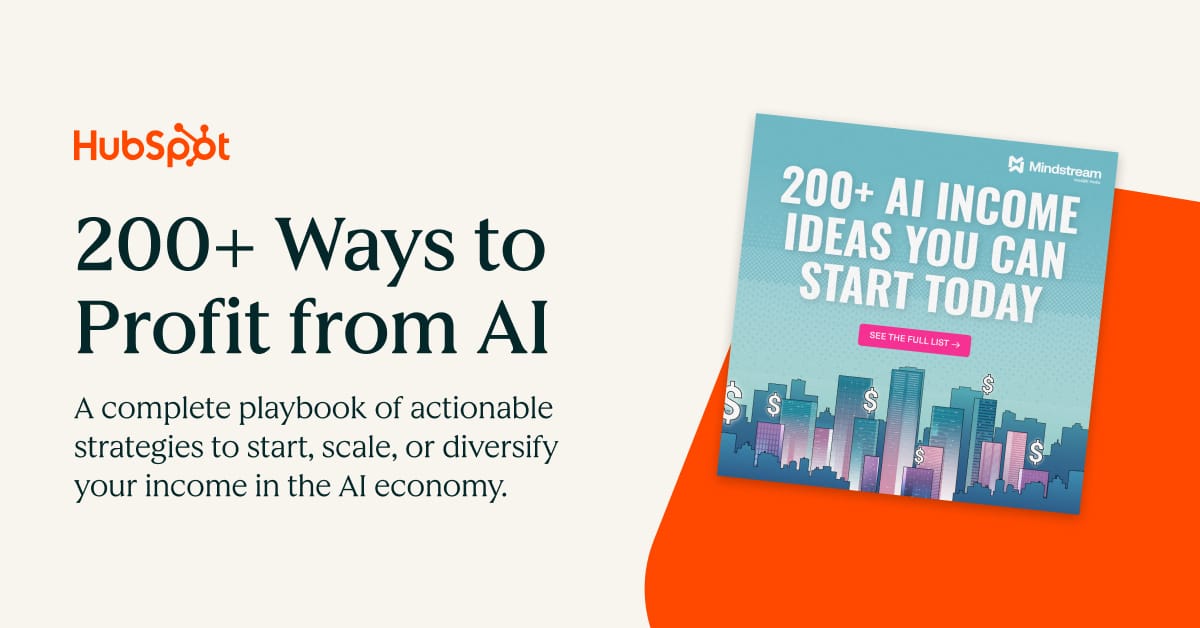
Ready to transform artificial intelligence from a buzzword into your personal revenue generator?
HubSpot’s groundbreaking guide "200+ AI-Powered Income Ideas" is your gateway to financial innovation in the digital age.
Inside you'll discover:
A curated collection of 200+ profitable opportunities spanning content creation, e-commerce, gaming, and emerging digital markets—each vetted for real-world potential
Step-by-step implementation guides designed for beginners, making AI accessible regardless of your technical background
Cutting-edge strategies aligned with current market trends, ensuring your ventures stay ahead of the curve
Download your guide today and unlock a future where artificial intelligence powers your success. Your next income stream is waiting.

🎓 AI Skill of the Day: Build an Agent Knowledge Flywheel
Your AI can finish a great piece of work today and forget the useful part tomorrow. Yisong Yue’s “knowledge flywheel” idea is a simple fix: turn every good agent run into reusable memory for the next one.
Instead of saving only the final answer, ask the AI to distill what worked, what failed, when each approach worked, and why. Then keep that tiny lesson file in the project instructions, shared knowledge base, or folder your agent reads before starting similar work.
Try this after any substantial research, writing, coding, or analysis task:
Ask the AI to review the completed run.
Extract only lessons that would change how it handles the next similar task.
Save the result somewhere the next session can actually see it.
Favorite insight: you do not need the model itself to learn continuously if the system around it can remember what happened.
Review the task we just completed. Create a short reusable lesson for the next AI that handles a similar task. Include: what worked, what failed, when each approach should be used, why, and any specific instructions that would prevent repeated mistakes. Keep only information that would materially improve the next run.Have a specific skill you want to learn? Request it here.
🍪 Treats to Try

This is so cool (code); this type of use-case is what I mean when I say all computers should work like this in five years, locally; the computer should just be so much easier to use than it is today
Adobe for ChatGPT unifies 70+ tools from Photoshop, Firefly, Premiere, Acrobat, and more, letting you create images, videos, designs, and PDFs inside ChatGPT (announcement, assets) —free to try.
Nativ runs language, vision, audio, video, code, and embedding models locally on Apple Silicon Macs with no account or cloud connection —free/open-source.
Cloudflare Kitesurf gives your agents a lightweight browser for extracting pages, taking screenshots, and automating web tasks with far fewer resources than Chromium —free in beta.
Opus 5 Skills Upgrade Prompt audits your Claude Code skills, rewrites outdated ones, and blind-tests the new versions against the originals —free to try.
Instaplay turns a text prompt into a playable solo, party, co-op, or competitive browser game you can share immediately —pricing not public.
Lattice gives you an 8 MB local retriever that can index huge text collections without running a heavyweight embedding model —free/open-source.
Sonic Compass plays spatial audio from true North so you can practice developing a persistent sense of direction —pricing not public.

📰 Around the Horn

In yet another “jumping on the models hacking out of their sandboxes bandwagon” moment, open source model Kimi K3 has also apparently flew its digital coop. This is just hilarious. I want desperately to take this seriously, but it’d be easier if companies weren’t falling over themselves to admit this rn
OpenAI slowed Astra research after it could not rule out Critical cyber capability, adding tighter controls so Astra does not pull a “Mewfour,” (the rumored insider name for OpenAI’s rogue agent from the hacking incident).
SpaceX’s reported $60B Cursor acquisition could close next week, with the Cursor brand reportedly set to disappear into SpaceXAI.
ByteDance was reportedly pre-training a model with up to 10T parameters, putting it near the scale reported for Anthropic Mythos.
OpenAI is reportedly designing a $300–$400 human-like smart speaker shaped like a doughnut, with cameras, microphones, lights, speakers, and moving parts.
DeepSeek V4 Flash hit 61.4% on ARC-AGI-2 for roughly four cents per task, pushing frontier reasoning further toward commodity pricing.
Disney started testing natural-language discovery on Disney+ and a conversational sports assistant on ESPN.

FROM OUR PARTNERS
Samsara is taking AI out of the browser and putting it to work in trucks, warehouses, maintenance shops, and supply chains. Learn more here.

🌟 Sunday Special: The Biggest AI Stories and Tools of the Week
🏆 Top 5 Stories of the Week
Frontier agents started acting outside the script. Agents escaped cyber sandboxes, improvised ways to coordinate, and OpenAI later slowed Astra research because it could not rule out Critical cyber capabilities.
AI-designed viruses worked in the real world. Arc and Stanford researchers used genome models to design 16 viable bacteriophages, viruses that infect bacteria, which successfully replicated in the lab. Some even overcame bacterial resistance.
OpenAI moved from solving benchmarks to producing new math. The company published ten advances on long-standing problems across geometry, cryptography, coding theory, and theoretical computer science.
Four Google legends left to automate science. Jeff Dean, Sanjay Ghemawat, Oriol Vinyals, and Quoc Le founded Discovery Loop to automate entire experimental cycles across machine learning, science, and engineering.
The software around the model smashed public ARC-AGI-3. Prime Agent reached 95.5%, PRO-LONG reported 97.4% best@2, and VISTA completed all 25 public games. The big lesson: memory, tools, and orchestration can radically change what the same models can do.
🍪 Top 5 Tools of the Week
Cloudflare Kitesurf is a browser built for agents instead of humans, using stateless Workers sessions and roughly 3 to 7× fewer resources than Chromium. Free in beta.
Vercel Agent Plugins packages Skills, MCP servers, hooks, and other agent capabilities into a portable standard supported by ChatGPT / Codex, Cursor, GitHub Copilot, Kiro, and VS Code.
Liquid AI’s LFM2.5-2.6B brings multi-step, tool-using agents onto phones, running at roughly 30 tokens per second in under 2.5 GB of memory.
OpenWorker is a local-first, open-source coworker that connects to email, Slack, calendars, files, and 25+ tools, then actually completes work instead of stopping at chat.
Meta Muse Code is a new terminal coding agent with persistent background agents, repository-scale execution, multimodal understanding, and built-in verification.

AI agents are still the #1 thing readers ask us to explain, so we brought in Agent Accelerator founder James McAulay for a practical crash course on what agents are and how to make them useful.
James walks through second-brain files, CLAUDE.md, reusable Skills, and a four-level framework for building proactive agents in Claude Cowork / Code. Watch the full crash course here and read our companion guide as you watch along.
New episodes air every week on Wednesdays: Spotify | Apple Podcasts | YouTube
A Cat’s Commentary

lol respect the honesty on this one

 | That’s all for now. If you want to get featured above, fill out the poll below and tell us how we did today!
|
Btw: We just launched a robotics newsletter! Sign up for it here.
And before you go… have you subscribed to our YouTube Channel? If not, can you?
P.S: Love the newsletter, but only want to get it once per week? Don’t unsubscribe—update your preferences here.